
Cost visibility, savings, and chargeback for Kubernetes.
See spend by team and workload, catch idle and over-provisioned resources automatically, and export chargeback reports finance can use directly.
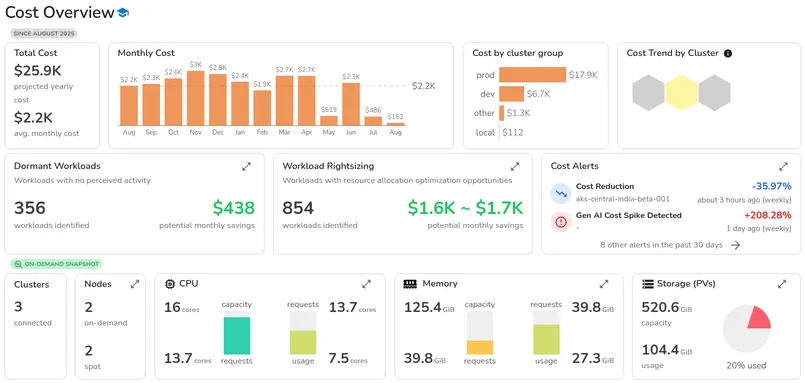
A Canadian public sector institution cut its Kubernetes spend by 45% with Randoli. The reduction didn't come from one change. It came from months of evidence-gathering: cost reports broken down by workload and team, rightsizing recommendations, and historical trends showing how consumption actually moved over time.
What their platform team valued most wasn't the recommendations themselves. It was being able to validate each cost decision against production telemetry first, answering "will this save money without hurting reliability" with data instead of a guess.
That turned the work from simple cost cutting into engineering-led optimization. Every change was justified on both spend and reliability, which is why the savings held instead of quietly reversing the next time a team hit a performance problem.
Cluster cost broken down by namespace and workload, with separate CPU, GPU, memory, and network breakdowns so you know exactly what's driving spend.
Set budgets on an absolute value or a percentage increase, for both Kubernetes and GenAI costs, and get paged the moment one's breached.
Rightsizing recommendations based on actual resource usage, not estimates.
Surfaces over-provisioned and idle resources automatically, before they show up as wasted spend.
Exported through the same API as the rest of Randoli data, ready for finance tooling.
Token spend and GPU utilization for AI workloads, alongside the rest of your Kubernetes cost data.
Cost-conscious and coming from Datadog or Dynatrace? See how the billing models compare.